
Will High Temperature and Humidity Accelerate the Degradation of PCP Cylinder
When PCP cylinders are stored in hot and humid conditions, do they deteriorate more quickly? Does the heat and moisture shorten their life, especially in regions like Southeast Asia, the Middle East and South America, where warehouses are always damp and hot and shipments take long time? Some purchasing managers even fear that cylinder performance starts to fall already when these are still delivered to the end-users. This concern is, in fact, quite a fundamental one because it hinges upon the material choice, the design of the structure and even the daily usage habits.
How can heat affect PCP cylinders?
PCP cylinders are intended for use under high pressure, thus the materials used need to be of the highest quality, especially for pressures of 200 bar and 300 bar. The biggest threat to a cylinder is not necessarily a high temperature under normal conditions, but rather a very quick and significant temperature rise that happens due to continuous exposure to sunlight or a very restricted space. If the material of the cylinder is inferior and the treatment of the inner surface is not done properly, then the abuse of high temperatures combined with recurring pressure changes can, indeed, speed up the fatigue process.
The Snow Rain PCP cylinders are made of 6061A aluminum alloy for the main body, with a good fatigue-resisting property. It is a fact that inflation and deflation are repeated in a PCP system, and happen hundreds of times each year. That is why the design also includes stress areas which have been reinforced to prevent the damages and aging that arise e.g. from increasing and decreasing the temperature.
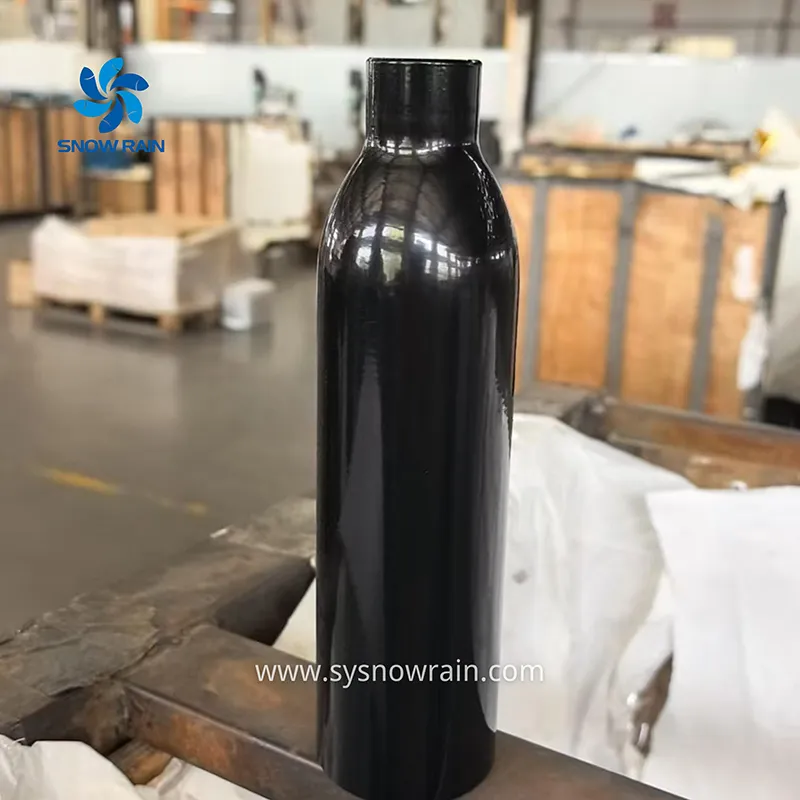
Isn't a humid environment even worse? It's actually the key that is inside the cylinder.
Humidity is a factor that tends to be ignored even more than the heat.
A good many customers think first of the appearance of rust on the casing but, as a matter of fact, the factor that most often influences the lifespan of the cylinder is the water vapor present inside the cylinder.
Standard steel cylinders are rusting and shedding powder surfaces when exposed to moisture for a long time, which probably leads to the damage of the pressure regulating valve and the seals, thereby the whole PCP system would get unstable. On the other hand, aluminum alloy is a material that gives a very clear edge in this respect.
The inner wall of the Snow Rain PCP gas cylinder is formed of 6061A aluminum alloy resistant to rust, which also resists oxidation and has the surface smooth. The compressed air itself is clean and mild enough for the valve core and sealing ring, so there is no fear of operation getting unsafe even if it is done in hot and humid places.
Therefore, before buying a gas cylinder one should initially seek a decisive answer from the seller as to what kind of material is the inner wall of a PCP gas cylinder made of? Is it safe from corrosion?
The answer to this question is certainly much more important than the look of the product.
Surface treatment is one of the most crucial factors for products in humid and hot regions; the outdoor environment simply cannot be overlooked.
Because of the high humidity inside the warehouse and a strong marine salt spray outside, if the outer coat is too thin, rust spots will show very soon, which might be even more of a concern for end customers. Yet, snowrain-type products come with various surface treatment options like anodizing, powder coating, and laser marking, which can be a choice of the buyers.
Anodizing is particularly good against the moisture coming from the environment while powder coating is really best for product differentiation and identification.
For the OEM buyers, this is also a factor on which they can give their approval: a clean and durable-looking cylinder has a higher chance of getting the customer's acceptance.
Eventually, your buyers will also think about that like:
Will frequent cycling of the battery combined with extreme weather (hot and humid) result in such a degradation of the battery that the capacity will be significantly lessened?
Places with such weather conditions characterized by daily cycles and moisture, how much will the cylinders suffer from the cycle if they are used daily by the means of target practice as well as inflation?
The lifespan of a gas cylinder takes into account the following three key factors:
Material properties, design, and if a charge-discharge cycle is meant for the cylinder.
Snow Rain's handy cylindrical gas tanks are the best choice if you want something that can go through several cycles. The 6061A aluminum alloy has a really good resistance to fatigue and when combined with an optimized wall thickness will give you a durable product for many years.
This aside, if a cylinder is of the highest quality, one must still refrain utilizing it beyond the set pressure. As an illustration, a 200-bar tank shouldn't be filled with 200 bar or more, and a 300-bar won't be pressed past 300 bar – basic things to remember always.
From a purchasing perspective, many brands are now gradually shifting from the use of traditional steel cylinders to aluminum alloy PCP cylinders, simply because:
Light – sometimes it is really hard to carry your gun along the way.
Rust-free – the market stays more stable in the hot and humid weather.
Inside cleanliness – longer life of the valve
Support OEM – Branding made easy
Snow Rain's PCP cylinders, which come in both 200 bar and 300 bar standard working pressures, allow for customization of specifications such as types of interface, capacity, color, and logo making them quite flexible for buyers who are involved in channel development and brand projects.
Subsequently, distributors who want to stand out can simple have anodized finish with laser branding stand out and attract customers in the store at a glance.
Let's revert to your first question.
Does high temperature and humidity really shorten the lifespan of PCP cylinders?
The cylinders that are made of ordinary materials, with the inside that is not sealed very well, can easily pick up the problem in such weather conditions as humid and hot.
That notwithstanding, if we speak about the products like snowrain PCP cylinders, the temperature and humidity factor alone will not be enough to deteriorate their quality, especially when the usage is correct and they are constructed from 6061A aluminum alloy, have structural stability, and require multiple surface protection options.