
Comparison of Pressure Grades of Aluminum Carbon Air PCP Cylinder
When we speak about PCP air guns, paintball systems, and applications using high-pressure air, the pressure rating of the Aluminum Carbon Pcp Cylinders always takes one of the top spots in the list of things that matter. Should we go for 200bar or 300bar? While at first glance, many would think, the higher, the better, over time, the users realize that the main issue should be the stability and the durability of aluminum-carbon air PCP cylinders over numerous inflation and deflation cycles rather than the pressure used
1.Why then, is cyclic charge-discharge testing preferred over merely the pressure rating value?
Pressure testing is essentially about safety and is mainly used to see the limit of the material. However, cyclic charging and discharging focus more on longevity.
Just think about it, cylinders are used repeatedly and do not expect to be used once only in reality. They go through cycles of filling, using and re-filling. Pressure changes cause the material to be under constant stress. That is why Aluminum Carbon Pcp Cylinders' cyclic performances provide a more reliable basis for their evaluation than single pressure parameters.
2. Recycling Features of 200bar Aluminum Carbon Air PCP Cylinders
It is true that the rating of 200bar is very common for the range of entry-level and mid-level powers, especially for airgun systems that are dedicated to training and recreational use.
From the perspective of cyclic charge-discharge, 200bar has a major strength in its relatively low pressure swings. The aluminum liner will, under such scenarios, slowly develop the fatigue due to repeated compressions, while the carbon fiber and glass fiber layers on the outside mainly serve as a stabilizing support.
In general, a 200bar Aluminum Carbon Pcp Cylinder could maintain good and stable level performance during slow gradual inflating rate and without the condition of rapid high-temperature inflation.
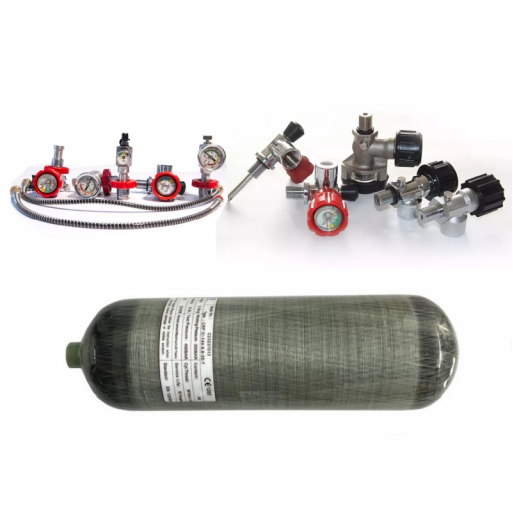
3. 300bar aluminum-carbon-air PCP cylinder's performance testing is more focused on challenging the structural design
Without a doubt, the 300bar pressure rating does give more gas volume and thus the running time is longer.
But, if you look from the other side of the coin, then it actually gets more complicated.
Aluminum liner at a higher pressure will suffer from greater stress changes during each inflation and deflation cycle. If the liner is of low quality or the carbon fiber winding layer is not evenly spread, then after a long period of cycling operation, micro-fatigue can happen very easily.
Hence, high-pressure aluminum-carbon-air PCP cylinders need to go through the most heavy-duty material combinations and production processes.
4. Aluminum Lining + Carbon Fiber Structure: Their Role in the Cycle
The aluminum lining is the main part of the gas container that is in direct contact with the gas as well as making the interior surface smooth which in turn helps to lower the chances of contamination and corrosion.
The carbon fiber and glass fiber encased the entire bottle to carry the load of the structural stress during the cycle together.
Once a composite structure such as this, is exposed to repeated charge-discharge cycles, it ends up benefiting the most through:
Stress is not concentrated at one single point, rather, it is spread out across the whole bottle
5. Different pressure levels require different usage habits.
Often times problems of poor circulation are attributed to "the pressure level itself" whereas in fact, half of the time it is an issue with the kit usage.
Let us use 300bar as an example of the case. If you do several quick inflations consecutively, the gas keeps getting heated and if you also release the air straight away, the system is being put under extremely high stress too often.
On the other hand, if cooling is adequate, and the inflation is done in a normal manner, even high pressure will probably not be the main reason performance deteriorates.
In essence, not only is it a pressure level issue, the higher ones imply that there is indeed a really great need for users to follow the instructions to the letter.
6. The Vital Role of Safety Features for Recycling
When operating in cycles repeatedly for a long time, safety relief valves and pressure gauges are definitely not only decorative elements.
They surely do not aid materials in extending their life. However, they certainly help users to avoid overpressure, wrong operation, etc., thus, indirectly, the Aluminum Carbon Pcp Cylinder's structure is being shielded.
This is among the reasons why the "visibility" of pressure changes is so crucial to systems, which are often used and thus become very significant in terms of wear and tear.
Therefore, it is not surprising that when users evaluate aluminum-carbon-air PCP cylinders, at times they even insist on the feeling of security that these Aluminum Carbon Pcp Cylinders provide.
7. It's not just a matter of comparing the specs of 200bar and 300bar only.
200bar is usually more controllable and therefore stable for continuous high-intensity professional training sessions.
On the other hand, 300bar will provide the user with a bonus if the goal is to be able to use the equipment the longest time at one go.
Basically, this is a question of deciding, not which one is better, but which one is more suitable for the actual situation.
8. Circulatory Manifestations: Eventually Back to Manufacturing Details
In the end, after a number of cycles and a long time, it will be very obvious what material consistency, winding process, and liner surface treatment actually are.
Some very minor differences that are not easy to spot after only a few uses, become quite apparent after many cycles.
Hence, while aluminum-carbon-air PCP cylinders were primarily bought based on the technical specifications only at one point in time, now more and more purchasers are considering the manufacturer's system,certifications, and stability over time.