
Comparison of Small-Capacity and Large-Capacity PCP Cylinders in Project Use
PCP cylinders are increasingly being chosen as the main air storage medium at very high pressure for industrial spraying, automated production lines, pneumatic tools, and testing equipment.
It is also a requirement by international standards for the use of high-pressure cylinders and EU CE directives for pressure equipment that cylinders should not only be designed for the pressure rating but should also consider factors such as the weight, service life, and safety features.
From a practical point of view, engineers and equipment integrators are continuously pondering the question of what type of PCP cylinder, low-capacity or high-capacity, they should buy when making a decision.
Based on the common design principles of high-pressure composite cylinders in the engineering field, this article reviews the two capacity options. It also refers to the ISO 9001 quality system and composite cylinder structural standards requirements about aluminum alloy linings and carbon fiber winding processes.
1. Usage Features of Small-Capacity PCP Cylinders.
Small-capacity PCP cylinders are mainly applied to mobile equipment or projects with limited space.
Applying the weight-saving design philosophy of high-pressure cylinders, this study shows that aluminum alloy linings combined with carbon fiber and glass fiber winding can radically reduce the total weight while still accommodating 200 bar or 300 bar working pressures.
The highlights are: Easy to handle and replace, thus, portable equipment-friendly; higher productivity at workstations with frequent start-stop cycles; less structural support needed, which means less installation work.
On the other hand, when viewed from continuous operation, small-capacity cylinders are the ones that get emptied rapidly and hence require more refilling, so just think about automated production lines or long-cycle testing- there, increased downtime and management costs will be the result.
2. Large-Capacity PCP Cylinder Project Performance.
Large-capacity PCP cylinders logically fit continuous operations better in spraying systems, centralized gas supply units, and industrial testing platforms.
Following the safety design principles for high-pressure vessels, large-capacity cylinders will frequently include safety valves and pressure gauges to ensure pressure bearing and monitoring over time.
Here is a list of their merits: operating time between refills is significantly extended; manual intervention is minimized leading to a more stable production line; centralized gas supply and modular system integration-friendly.
One needs to be aware of the fact that big capacity cylinders have to be bigger on the outside, they will need more space for installation and stronger structures for support.
3. Which one to pick - 200bar or 300bar?
Basically, 300 bar PCP cylinder can store twice as much air at the same volume, so it is a more suitable solution for situations where long endurance is required; a 200 bar solution, however, represents a more straightforward option in terms of filling equipment matching and maintenance cost.
It is not pressure value alone that drives the purchasers' decisions, but also the following points:
- How frequently the equipment is used
- If a high-pressure filling device is available on-site
- Equipment interface compatibility
- Local legislative provisions for pressure-bearing equipment
4. Why choose Our Aluminum-Carbon Composite PCP Cylinders Version?
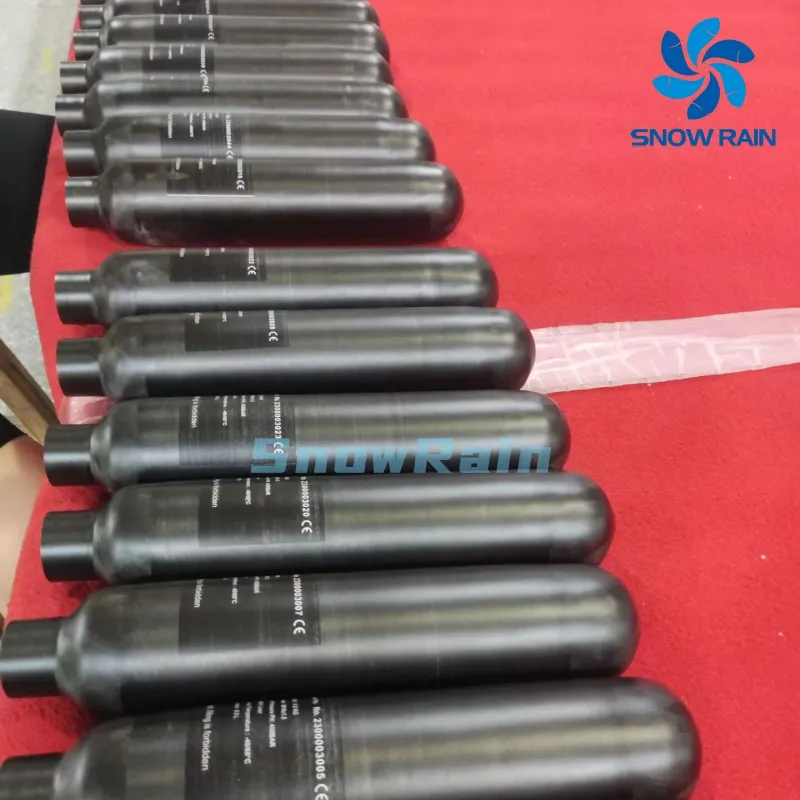
Our PCP cylinders embody the most advanced innovations of the composite cylinder industry and consist of a fraction of an aluminum alloy liner + carbon fiber, and glass fiber fully wrapped, providing a CE-certified product. Our factory operation system is in line with ISO 9001 standards; these are all major reference points for today's international engineeringprocurement.
The major product advantages are:
It can handle 200bar/300bar working pressure
The unique inner wall is chemically treated for wear and corrosion resistance
A standard safety valve and a pressure gauge are fitted, which conform to the safety regulations of high-pressure equipment
Compatible with multi-brand pneumatic equipment interfaces
Matte black or glossy black surface finish is available to meet different project aesthetic requirements
You can mix and match various capacity, interface, and color options to achieve easy system integration
5. Why do engineering procurement companies choose SnowRain?
For B2B clients, purchasing a PCP cylinder is not merely buying a gas cylinder but rather selecting a long-term project partner.
It is a fact that SnowRain not only looks to CE pressure equipment requirements and composite cylinder manufacturing specs to base the design phase on but establishes a full traceability system from the selection of raw materials, winding process, and factory testing.
Besides that, we offer selection advice on the basis of different project applications, helping clients to make the right choices between the small-capacity and the large-capacity options in line with the site conditions.
Suppose your project requires a stable supply of 200bar/300bar aluminum-carbon composite PCP cylinders, or customized specifications for system integration. In that case, we are ready to help you with sample testing, technical parameter confirmation, and bulk delivery cycles.
Reach out to SnowRain for PCP cylinder solutions tailor-made for your engineering projects.